When does an underdog stop hustling?
- entrepreneurship
- business-strategy
- personal-growth
- mentorship
- innovation
Why couldn’t you stay small? -A competitor, a former partner or a supplier might ask. In my previous life, years ago, I was producing shows and concerts. At first, they were all small scale. Then they grew. Quick. From a dubstep music producer from New Zealand to then huge LMFAO (Sorry for Party Rocking’), big and emerging Ellie Goulding, B.o.B and more. A competing show promoter, who run a concert venue, started making my agency’s life hard in different ways, due to confusing the two business directions. In one case, we were competitors, but in this case we were partners, where the venue should appreciate an active tenant and demanded acts being brought to it. Once when there was another issue at the venue I came to speak to the show promoter, the partner at the venue. Before I left he murmured, “Why didn’t you stick to those small electro shows.” That was the last time we had a normal conversation. Most start-ups at acceleration programs, to which I am affiliated, are underdogs. Being a young coach, mentor, and judge at Alchemist Accelerator, different European Commission's Horizon 2020 financed acceleration and innovation funding programs, and other early business support initiatives has been a challenge, but I know I am in the right place when I look back on my experiences helping teams to be ready. I can share wins and losses. I’ve matured a firm from an underdog to a large player. I’ve been trampled down. This all provides me with a wealth of knowledge. We learn best from our experiences.
Are you an underdog?
Ventures often start first being customers, partners, or suppliers of their future competitors. You would not build a car without ordering parts from or designed by a competitor. It is hard nowadays to come up with a solution without improving or remaking something someone else has built already. First, as a small firm, you might experience such reactions of other firms surrounding you: ● A sympathy and a willingness to support the enthusiastic individual or team ● A dislike and reservation of an incomprehensible and unpredictable small thing ● A form of an ignorance for being of such a small size and low importance
Who should you be afraid of?
Everyone, most likely.
Who should you be friends with? Anyone, if you figure out why they should.
Who should you be careful around? Everyone. The attitude will change when you’ve advanced.
So what is the underdog?
Wikipedia states it is a person or a group in competition, who is popularly expected to lose. In the movie and book Moneyball, the team itself was an underdog in a league, players obtained were underdogs, an assistant – analyst was an underdog. In the business world, e.g. fintech, start-ups in general were first underdogs – unwanted but unappreciated by banks, or smart mobility startups - ignored by taxi, car and bike hiring firms.
As Barack Obama goes in his book, A Promised Land, Donald Trump first appeared on the landscape as an annoying shape. First, then the President tried to ignore the underdog. Then, with time, Mr. Trump's powers grew. At one point, B. Obama was forced to give credits to the person, which indicated that the future President was no longer just an annoying thing.
To make it simple, imagine a bunch of dogs, with a small, seemingly weaker member or newcomer, which challenges a bigger one, the favourite of the dogs. Everyone expects the popular dog to win. Same expectation on the other dog to lose. One is brave, strong, and a long-lasting leader, another is a ridiculous being. And then the unexpected happens. Rules of the fight might be changed.
If you are a bad chess player, try having a match with someone who is good. Just before the game, challenge him/her to change the rules a bit. Imagine that the boundaries of the chessboard do not limit the game, and it continues on the opposite side of the board.

What happened?
The rules, the surroundings, and the situation have changed. The experienced player was used to old surroundings and applied the same trusted strategies to new rules which lead to the confusion. There was nothing that confused you. You did not have a strategy or a know-how. Do another experiment. Have a few more matches with the player, and you will see how they adapt and you might be in trouble again.
You only have one shot
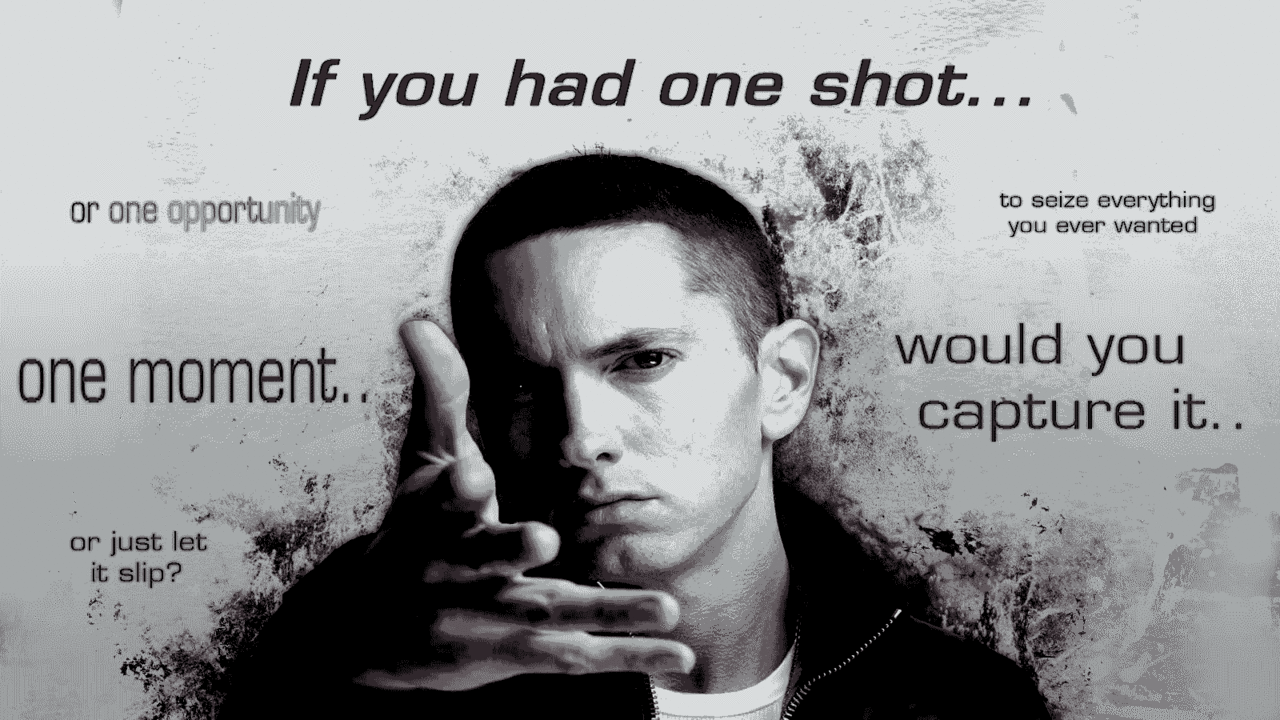
One chance – it is all a new player needs, right? Change the rules if necessary, but be quick to make use of any confusion. But before starting – be sure you have guts and persistence needed. As Eminem raps in Lose Yourself, You better lose yourself in the music, the moment You own it, you better never let it go You only get one shot, do not miss your chance to blow This opportunity comes once in a lifetime.
P.S. Maybe it is still a good idea to think of a strategy for the new rules before you play.